The Iran I Have Seen
Writings on the protests, riots, the internet, and the current state of Iran
Published on February 15, 2026
As protests began brewing in Tehran and other places, Shiraz remained calm. Despite the chaos, my routine remained disaffected. A local shopkeeper that I often visit, claimed that the government had just two months left before they would be ousted. I would hear this often, to which I would respond with a chuckle and a lighthearted joke. It’s funny, because he would say this nearly every time I met him, it was like he was trying to will it into existence.
While the protests intensified elsewhere, Shiraz was still quiet, except for one occasion when a brigade of motor police, wearing Kelvar vests and armed with AK-47s, drove by. On the night of January 6th, before the peak of the protests and riots, a middle aged lady was yelling at the top of her lungs from her apartment. I initially thought it was a domestic dispute, but in hindsight, her dispute was with the government.
Shiraz grew louder as the protests continued on the night of January 7th. Most shops kept their shutters closed. Even the 24/7 supermarket was closed. Only pharmacies, hospitals, and opportunistic shopkeepers were open during the day. The seriousness of the situation dawned on me the night before the peak of the protests and riots. I heard cars honking their horns at the intersection near me. The honking abruptly stopped after the sound of two gunshots. I checked local twitter accounts to see if anyone else was talking about the sounds I just heard. Soon after, the apartment complexes surrounding me began to chant anti-government slogans. Almost like a call and response, an elderly woman would lead the chant from her window, while the other apartment dwellers would chant back in unison.
The nights of January 8th and 9th were particularly loud, which is when the protests started to get serious. The timing of the internet blackout was almost perfect. During the first few days of the internet blackout, which coincided with the peak of the protests, not even SMS worked and international calls were not operational until January 13th. Even most Iranian domestic apps did not work for the first couple of days. Just a few hours before Shiraz erupted, I could hear street protests, gunshots, neighbors' chants, and car honking echoing throughout the city.
Along with the deteriorating economic situation, Trump and Reza Pahlavi had riled people up. Chants like "Death to the dictator" and "Javid Shah will return", which could be heard from within my bedroom. The morning after was eerily calm and peaceful, but the sense of uneasiness and anticipation of more riots and protests permeated the streets. In my neighborhood, there were no obvious signs that protests had taken place the night before, other than the majority of shops still being closed during the day and new graffiti on the wall of an abandoned lot.
I usually did my grocery shopping in the morning. However, I became particularly hungry around sunset. Around 5:30pm on January 10th, I walked to the corner store that I frequent. The metal shutters were halfway down, preparing to close before the next round of protests. The shopkeeper knew me well enough to let me play a game of limbo to get in and out of the store. As I was leaving, the shopkeeper urged me to hurry home and quickly lock the door. He briefly explained that he did not want me to get arbitrarily detained and have the police make a bogus charge due to my status as a dual citizen. Soon after I arrived home, the protests started again.
The protests fizzled out after a couple of days and Shiraz returned to a state of relative normalcy. Stores were opening back up again, although it was a common occurrence for shoppers complain about the cost of food increasing on an almost weekly basis. The shop owners could only say, "unfortunately, it is what it is". Anti-government graffiti was painted over. Vandalized mosques and other buildings were being repaired. Despite this, you could feel that there was still a thick air of paranoia and nervousness. About a week after the most violent nights, one of my neighbors tried to start a "death to the dictator" chant again from her apartment, but it was cut short when another neighbor yelled out "death to your mom". However, the internet was still out.
Before coming to Iran, I did make several preparations because I knew that the internet speeds were less than optimal and the power frequently went out during the summer months. I have a T420 ThinkPad running Artix Linux (I hate soystemd, but that's a story for a different time) with a couple of external hard drives with various books, movies, television, and other media. I also have a MacBook for other administrative tasks. I was able to stay productive when only Iran's domestic internet was accessible. I do regret not setting up Psiphon or any similar technology, but I doubt it would have worked decently during the internet outage.
In my opinion, Iran's technological infrastructure is adequate but there is some room for improvement. There is almost a domestic clone for every popular western social media app. However, some people inherently don't trust Iranian social media apps because of their association with the government. Also, there are plenty of official streaming sites where you can watch Iranian movies and censored western movies. It is a hilarious concept to me that the official streaming sites in Iran most likely torrent foreign films, edit them to please the Ministry of Culture and Islamic Guidance, then upload them to the website behind a paywall. In addition, there are also a couple of semi-public media servers with uncensored movies and television shows. One of the main problems in Iran is that the (bio)masses want their Instagram, YouTube, and other attention-stealing apps. Instead of Che Guevara shirts, you have the youth wearing knock-off designer and Travis Scott shirts. A common occurrence throughout the Third World. You ask people what their favorite television show is and you'll often hear either Breaking Bad or Game of Thrones.
During my time exploring what Iran's domestic internet had to offer, I decided to access Aparat, which is Iran's video-sharing and streaming platform. I wanted to observe what the streaming scene was like on this website. Turns out it is just like Twitch, Kick, or any other streaming website. The same types of personalities and behaviors appeared on Aparat. Though, the moderation is stricter to comply with the law, so you do not see the same exact shenanigans as you do on Western streaming sites. I will admit I was a bit surprised that the same parasocial behavior that exists in the west festered in Iran as well. Women sat there thanking their donators more often than they did playing video games. To me, the amount of money that these streamers were making starkly contrasted with the terrible economic conditions that the country faced. One stream I watched, there was a particular woman streamer who had a jump-scare notification whenever someone donated a certain amount. Apparently, this is a common thing among the streamers on Aparat. The charade of the streamer getting upset at the men donating, then getting more donations was amusing to watch. Chat functionality on Aparat livestreams had emote-only mode enabled. You can guess why that was the case from the screenshot below.
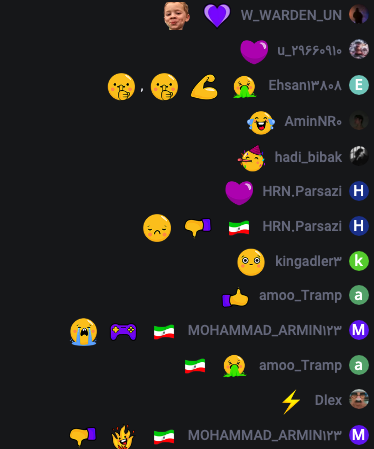
A glimpse of emote only chat on Aparat.
Some people tried to take advantage of the situation by claiming they had a working proxy or VPN to gain viewers and donations. To my surprise, there were a handful of streamers who actually had a working configuration and shared it with anyone watching. The problem was either that the proxies would last for a couple of hours before getting shut down, or that it took an hour to establish a VPN connection that would disconnect after a minute. Aparat would also ban these people for violating their terms of service if they caught them. Despite the frustrating experience with the barely functional VPN, I would queue up messages to my family and friends and wait for the VPN to connect. I also used my limited window of opportunity to refresh my RSS feeds. The relative silence from the outside world and not being bombarded by useless information were beneficial to me. For me, the government-mandated "dopamine detox" and cognitive warfare counter-operations were fairly successful. Although not being able to contact friends and family to tell them I was safe was worrisome.
About two weeks after the internet blackout started, the first websites to fully work were Google[1], ChatGPT, and DeepSeek[2]. I found this decision interesting. In my opinion, this reflects Iran's confusing foreign policy where it does not fully commit to the West or the East. A move that undoubtedly contributes to Iran's current and ongoing predicament. The internet started opening back up again, albeit at a snail's pace and with frequent disconnections. Before the internet outage, I was aware of the level of cognitive warfare waged against the Iranian population. Reading back through what people were "reporting" during the internet outage confirmed that for me even more. The contrast between what I experienced on the ground and what was being said on the internet during the blackout was interesting and entertaining. Some commentators were absolutely certain that Trump was going to bomb Iran during the riots. Even young people I talked to here thought the same thing. Some people I interact with here sometimes bring up how they want Trump and/or the Zionist entity to bomb Iran. On one occasion, I jokingly told an acquaintance how messed up the situation was that he was begging an alleged "bache baz"[3] and a close associate of Epstein to save them. I did find the number of people living here who share this sentiment to be surprising, but contrary to the annoying and louder voices on the internet, the opinions of the Iranian people are more diverse and nuanced.
During the occasion of the anniversary of Khomeini's return to Iran and the Iranian Revolution, the celebrations seemed louder than they were the previous year. I got the feeling that those celebrating were rubbing it in the faces of those who oppose the government. I could only imagine what the people who had been out in the streets during the protests and riots the month prior were thinking when the sounds of fireworks and celebratory gunfire were going off. If the people who were hoping for the overthrow of the government were not fully demoralized, I am sure that this sealed the deal.
At the time of this writing, the negotiations between America and Iran are ongoing. Who knows what will happen next. If I had to guess, it will only get worse before it gets better. But that might be wishful thinking.
[1] I resent the government for not opening up DuckDuckGo instead, despite their shady reputation.
[2] As a fan of DeepSeek, I used it as a convenient way to communicate with loved ones by sharing the login details of a new account while the rest of the websites were coming back online.
[3] Persian word for child molester